


MOST CLASSIC
Annapurna Circuit Classic Trek
One of the world's greatest mountain walks — circumnavigating the entire Annapurna massif via Manang, over Thorong La Pass, and down through Mustang's high desert to sacred Muktinath.
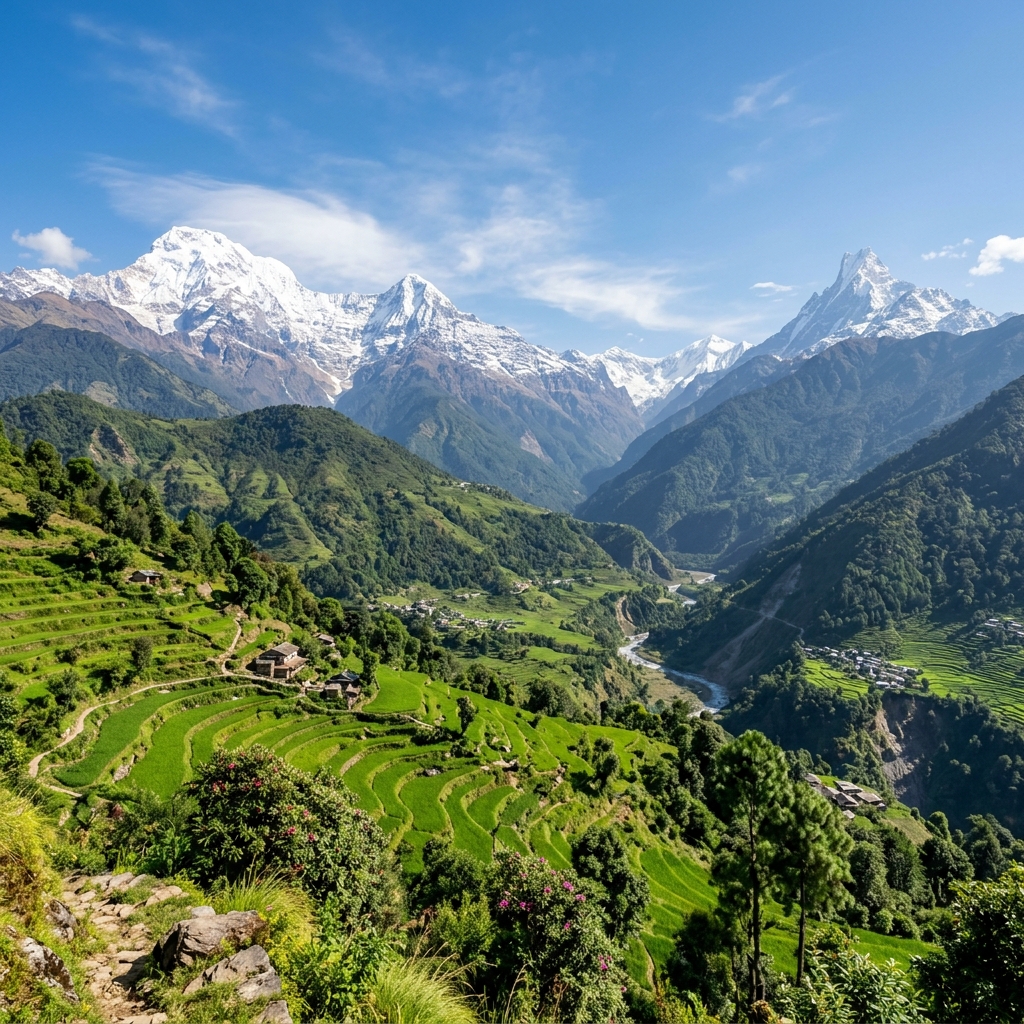
Nepal's most visited trekking region spans from subtropical lowlands to the 8,091m summit of Annapurna I. Walk ancient Gurung and Thakali trade routes encircling the world's highest circuit, from Thorong La Pass to the sacred Muktinath temple. Explore Geography →
The Annapurna Conservation Area Project (ACAP) is Nepal's largest protected area, encompassing 7,629 km² across the Gandaki Province. Established in 1986, it contains a staggering biodiversity gradient — from subtropical lowlands at 790m to the summit of Annapurna I at 8,091m — encompassing eight of Nepal's ecological zones in a single trek.
The region spans three distinct trekking corridors:
The classic Annapurna Circuit circumnavigates the entire massif via Manang, Thorong La (5,416m), and Mustang, descending through Jomsom's wind-sculpted high desert valleys.
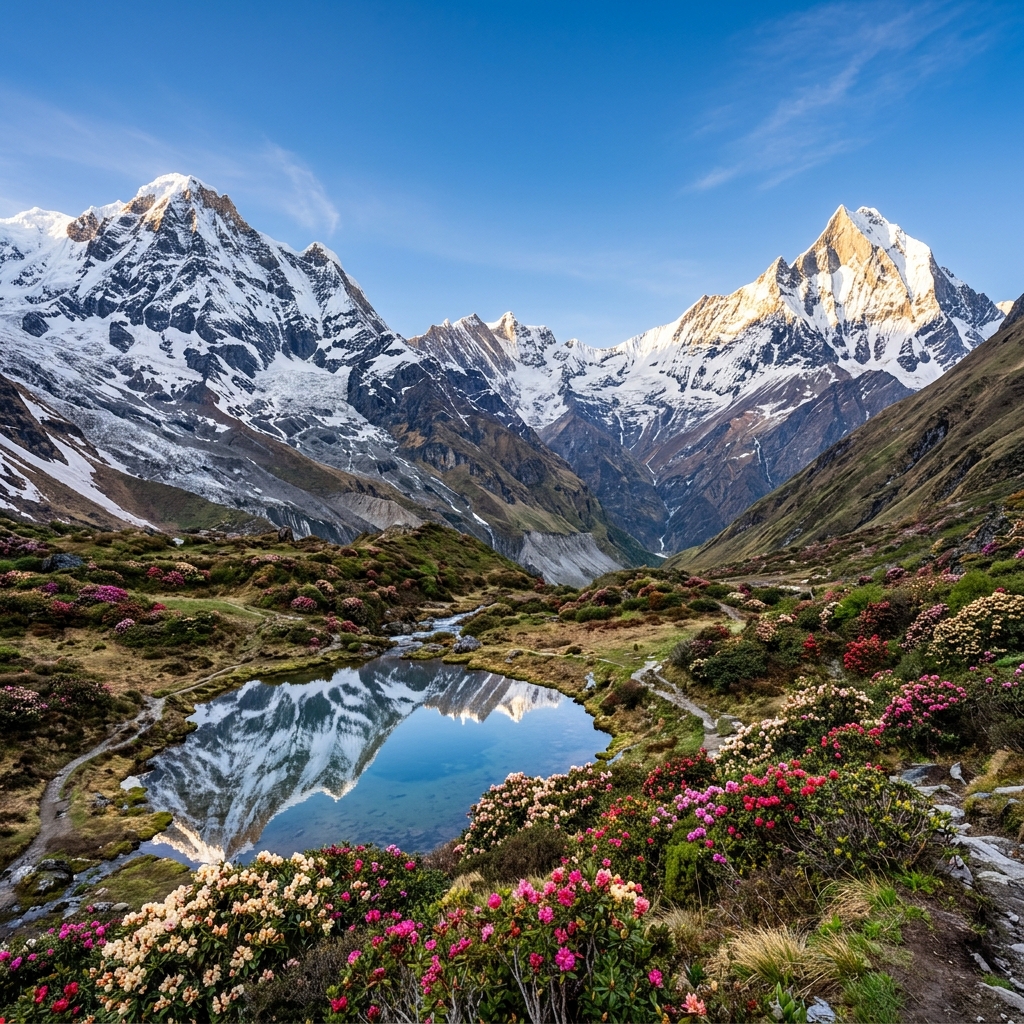
Annapurna Base Camp (4,130m) sits within a dramatic glacial cirque enclosed by 7,000m+ peaks on all sides — one of the world's most spectacular mountain amphitheaters.
The Ghorepani-Poon Hill circuit offers Nepal's most rewarding short trek with sunrise panoramas over 8 peaks above 7,000m including Dhaulagiri and the Annapurna south face.
From classic 14-day circuits to short 5-day scenic ridge treks, the Annapurna region offers Nepal's most versatile trekking portfolio.
MOST CLASSIC
One of the world's greatest mountain walks — circumnavigating the entire Annapurna massif via Manang, over Thorong La Pass, and down through Mustang's high desert to sacred Muktinath.
SANCTUARY BOWL
Walk through lush rhododendron forests past Machhapuchhre Base Camp into the iconic glacier-enclosed amphitheater at 4,130m, surrounded on all sides by walls of Annapurna, Gangapurna, and Hiunchuli.
BEST SUNRISE
Nepal's finest short trek. Through dense rhododendron forests of Ghorepani to Poon Hill's legendary viewpoint for sunrise colors painting Dhaulagiri (8,167m) and the Annapurna Range simultaneously.
HIDDEN GEM
Nepal's best-kept trekking secret. A narrow, forested ridge trail with jaw-dropping close-up views of the sacred Machhapuchhre (Fishtail) and the entire Annapurna south face, with far fewer crowds.
OFF-BEATEN
An untouched ridge trail above Ghorepani combining forests, high pastoral yak meadows, and the sacred glacial Khayer Lake — offering unobstructed views into the Annapurna South face from above.
RESTRICTED ZONE
One of Nepal's rarest restricted-area experiences. Entering via Koto off the Annapurna Circuit, this route leads into the remote Tibetan-plateau villages of Nar and Phu, virtually untouched by modern tourism.
All trekkers must carry valid ACAP and TIMS permits when entering the conservation area. We handle all permit procurement on your behalf.
Approx. USD $23 per person. Required for all trekkers entering the Annapurna Conservation Area. Valid for the entire duration of your trek.
Trekkers' Information Management System card. Mandatory for all trekkers in Nepal. Individual trekkers pay USD $20; group trekkers pay USD $10.
Special Restricted Area Permit (RAP) required for Nar Phu Valley. First week USD $90/person, each additional week USD $45/person. Requires licensed guide.
The Annapurna Circuit crosses Thorong La (5,416m) — one of the highest trekking passes in the world. Proper acclimatization is essential.
Severe headache, vomiting, loss of coordination, or confusion — DESCEND IMMEDIATELY. Never sleep at higher elevation if symptoms persist.
We coordinate with Fishtail Air and Karnali Helicopters from Pokhara. Travel insurance with helicopter coverage (min. USD $50,000) is mandatory for all trekkers.
Unlike Everest, the Annapurna region has remarkably consistent Spring and Autumn windows, with the rain-shadow effect allowing trekking in Mustang even during monsoon.
| Season | Months | Temp at Pass | Conditions | Rating |
|---|---|---|---|---|
| Spring | Mar – May | -5°C to +10°C | Clear mornings, afternoon clouds. Rhododendron bloom. Crowded. | Excellent |
| Monsoon | Jun – Aug | +5°C to +15°C | Heavy rain on south slopes. Mustang/Circuit rain-shadow zones viable. | Selective |
| Autumn | Sep – Nov | -8°C to +8°C | Crystal clear skies, sharpest visibility. Peak season — book 3+ months early. | Excellent |
| Winter | Dec – Feb | -20°C to -5°C | Thorong La may be closed. Poon Hill and ABC feasible for experienced trekkers. | Challenging |
The Annapurna region is the homeland of the proud Gurung people — formerly world-renowned Gorkha soldiers — who have farmed the lower terraced slopes for centuries. Higher up, the Thakali community of Mustang and Jomsom are legendary for their hospitality and spiced cuisine. In the high valleys approaching Thorong La, the Manang people maintain a semi-nomadic trading culture with deep Tibetan Buddhist roots.
The Annapurna region has Nepal's most developed teahouse network — from basic guesthouses to comfortable lodges with hot showers and WiFi.
Basic twin/double rooms with communal bathrooms. Cold water wash (hot shower extra ~$2). Perfect for budget trekkers. Blankets provided. Average: $8-15/night.
The Thakali "dal bhat" of the Annapurna is famous across Nepal — fluffy rice, thick lentil soup, seasonal vegetables, and achaar (pickle). Includes unlimited refills. Best value fuel on the trail.
WiFi available in most lodges up to Manang (3,519m) and Jomsom (2,720m) on the Mustang side. Higher on the circuit, Ncell sim cards offer 4G through Thorong Phedi (4,541m) on clear days.
What you pack determines your comfort on Thorong La. Layering is essential for the massive elevation range (800m to 5,416m) encountered on the Circuit.
Everything you need to know about ACAP permits, Thorong La crossing, seasonal windows, teahouses, and booking your Annapurna expedition.
The two peak seasons are Spring (March–May) and Autumn (September–November). Spring brings rhododendron blooms and stable conditions before afternoon clouds build. Autumn offers the clearest mountain views with post-monsoon freshness. October is the absolute peak month — book 4-6 months in advance for autumn departures.
You need two mandatory permits: (1) ACAP (Annapurna Conservation Area Permit) — NPR 3,000 (~$23 USD), and (2) TIMS Card (Trekkers' Information Management System) — $20 USD for independent trekkers. For the Nar-Phu Valley extension, a Restricted Area Permit is required ($90 USD/week). Best Treks Nepal handles all permits as part of our package price.
The Thorong La Pass (5,416m) is a long, demanding day — typically 6-8 hours of ascent (700m vertical) followed by a 1,600m descent to Muktinath. Always start by 4-5 AM to avoid dangerous afternoon winds. After a proper rest day in Manang (mandatory), the crossing is achievable for most fit trekkers. AMS (Altitude Mountain Sickness) is the main risk — our guides carry supplemental oxygen and Diamox.
Yes — uniquely, the Annapurna region's rain-shadow zones (Mustang and Manang-Thorong corridor) receive very little monsoon rainfall. Upper Mustang from Jomsom northward remains dry and trekable June–August. The southern approach routes (Ghorepani, Modi Khola Valley for ABC) experience heavy monsoon rain and are best avoided during this period.
The Annapurna Circuit has Nepal's most developed teahouse network. Accommodation ranges from basic guesthouses ($5-15/night) to comfortable lodges with en-suite bathrooms in Besisahar and Pokhara. The famous Thakali dal bhat (unlimited refills) is available in Jomsom and Kagbeni — widely considered Nepal's finest trail food. Most teahouses also offer pasta, pizza, momos, and apple products (famous in Marpha village).
Our all-inclusive packages cover: All permits (ACAP + TIMS), certified licensed guide, porter services, 3 daily meals (breakfast + lunch + dinner) at teahouses, all accommodation, ground transportation Pokhara-trailhead, and 24/7 emergency support. International flights, travel insurance, personal gear, and optional tips are not included.
Yes — travel insurance is mandatory for all our trekkers. It must include helicopter evacuation coverage to minimum USD $50,000 and medical coverage up to the trek's maximum altitude (5,416m for the Circuit). World Nomads, True Traveller, and Battleface are popular options for high-altitude trekking in Nepal. We verify your policy at check-in.
For October–November departures (peak season), we recommend booking 4-6 months in advance. Good teahouses in strategic acclimatization villages like Manang, Thorong Phedi, and Muktinath fill very quickly. Our groups are capped at 10 trekkers maximum to ensure personalized service and teahouse reservation flexibility.
Our Kathmandu operations headquarters and senior Gurung guides are available 24/7 to customize your itinerary.
Connect with our Pokhara and Kathmandu expedition teams to customize your itinerary, check live availability, or lock in your guaranteed departure date for the Annapurna region.